
Lamb County Criminal Court Cases
Court level determines the custodian. The 154th District Court is Lamb County's felony trial court. Texas Government Code §24.253 makes the district a single-county district. Its terms begin on the first Mondays in January and July. The District Clerk keeps felony indictments, pleadings, orders, docket entries, judgments, and sentences in Room 212 of the courthouse.
The constitutional Lamb County Court handles the county criminal docket within its statutory power, while the County Clerk keeps those misdemeanor case records in Room 103. Four justice precincts and each municipal court keep their own fine-only files. That division means a clerk may correctly report no record even though another Lamb County court has it.
Lamb County Court Record Routes
“The courthouse” is not a precise request destination. Lamb County places its two main criminal clerks in the same building, but on different floors and with different dockets. City and justice matters stay outside those two file sets. Match the filed charge to the office before asking for a search or copy quote.
| Court or office | Criminal case role | Contact route |
|---|---|---|
| 154th District Court / District Clerk | Felony indictments and district cases | 100 6th Drive, Room 212, Littlefield; (806) 485-0071 |
| Lamb County Court / County Clerk | County-level misdemeanor docket | 100 6th Drive, Room 103; (806) 485-0053 |
| Justice precincts | Precinct fine-only cases and magistrate matters | Official JP directory |
| Littlefield Municipal Court | City ordinance and Class C cases | 301 XIT Drive; (806) 385-5161 |
The county office pages do not publish complete counter hours, copy prices, or an archive retrieval schedule. Call before travel or before mailing payment. Ask whether the Lamb County court case is electronic, paper, archived, sealed, or available only at the counter.
Searching Lamb County Case Records
A cause number gives the clerk the cleanest match. Without one, provide the full name, an approximate filing year, and a date of birth if that office accepts it. Begin with the register of actions, sometimes called the docket sheet, because it identifies the events and filings worth ordering. Then distinguish a plain copy from a certified copy.
- Decide whether the filed case is a felony, county-level misdemeanor, municipal matter, or justice-court case.
- Contact the matching Lamb County clerk and use the cause number when known. Otherwise provide a full name and approximate year.
- Ask for the register of actions first. Use it to select the indictment, information, plea paper, order, judgment, or sentence needed.
- Search re:SearchTX as a second route for participating courts and electronic records.
- Confirm search, copy, certification, payment, and archive charges directly before placing an order.
There is no Lamb County public docket form on the inspected county pages. Their contact forms support an inquiry, not a full case search. A missing online hit is therefore a reason to call the clerk, not proof that no criminal case exists.
Lamb County Cases on re:SearchTX
re:SearchTX is the statewide e-filing record platform. It can supplement a Lamb County clerk search, but coverage and document access depend on the participating court, the record, and the user's role. Registration may be required. Search filters also vary with the available access level.
| Field | Type | Required | Use |
|---|---|---|---|
| Search by | Tabs or control | Route-dependent | Select person, case, or another offered mode |
| First and last name / business name | Text | For party-name route | Find possible party matches |
| Case number | Text | For number route | Best discriminator when known |
| County / court | Filter | No | Select Lamb County or the court when offered |
| Filing date range | Date filters | No | Narrow common-name results |
| Case type / status | Filters | No | Availability depends on indexed data |
Online access is not the same as the full local file. The clerk can address paper exhibits, archived volumes, certification, sealed entries, and documents that a remote role cannot open.
Note: Treat an empty re:SearchTX result as incomplete until the proper Lamb County clerk has checked the name, year, and court.
Inside a Lamb County Case File
A Lamb County criminal case file centers on the court proceeding. It can connect the State of Texas case style to a cause number, charge, lawyer, hearing history, plea, outcome, and sentence. It is more detailed about litigation than a jail booking, and more case-specific than a DPS criminal-history compilation.
| Cause number and court | Identifies the exact Lamb County docket and custodian. |
|---|---|
| Charging document | Shows an information, complaint, or returned indictment and the filed offense. |
| Docket events | Lists filings, settings, appearances, motions, orders, and other case activity. |
| Hearing and counsel data | May identify dates, hearing types, and attorneys of record. |
| Plea and disposition | Records whether the charge ended by plea, dismissal, acquittal, conviction, or another action. |
| Judgment and sentence | Can show punishment, community supervision, fine, costs, restitution, and sentence terms. |
| Later events | May include capias or warrant entries, an appeal notice, revocation action, or attached-document availability. |
Social Security numbers, full financial identifiers, protected victim or minor information, sealed material, and other confidential fields should not appear in the public view. Ask for a specific document instead of assuming the online docket includes it.
Lamb County Filed Charge Differences
A booked charge reflects the arresting agency's probable-cause basis at intake. The prosecutor then reviews the evidence and chooses what, if anything, to file. The charging paper may narrow, add, reduce, or reframe the allegation. Only the court record carries the filed charge through plea, trial, judgment, and sentence.
This distinction matters when a booking entry and a Lamb County court file do not match word for word. Use the arrest record to understand the custody event. Use the case file to learn what the prosecutor pursued and how the court resolved it. The broader Lamb County arrest lookup explains the agency and jail side of that trail.
- Information
- A prosecutor-filed charging instrument commonly used for misdemeanors.
- Indictment
- A felony charging instrument returned as a true bill by a grand jury.
- No bill
- The grand jury declined to indict the charge presented to it.
- Disposition
- The court case outcome, such as dismissal, acquittal, conviction, or deferred adjudication.
How a Criminal Case Moves
After arrest and magistration, the prosecutor reviews the matter. A misdemeanor may proceed by complaint and information. A felony may go to the grand jury, whose returned indictment becomes part of the Lamb County court file even though its deliberations remain secret. Arraignment calls on the accused to plead, followed by discovery, motions, negotiation, or trial.
Case flow: Charges Filed → Arraignment → Pretrial → Plea or Trial → Disposition → Sentencing
The court may then enter judgment and punishment, while an appeal travels to the Seventh Court of Appeals. Lamb County clerks and courts also report qualifying dispositions to DPS under Texas Code of Criminal Procedure Chapter 66. Reporting delay can make a statewide record lag behind the local judgment.
Lamb County Court Office Views
The official 154th District Court page shows the local office presentation for Lamb County felony court records.
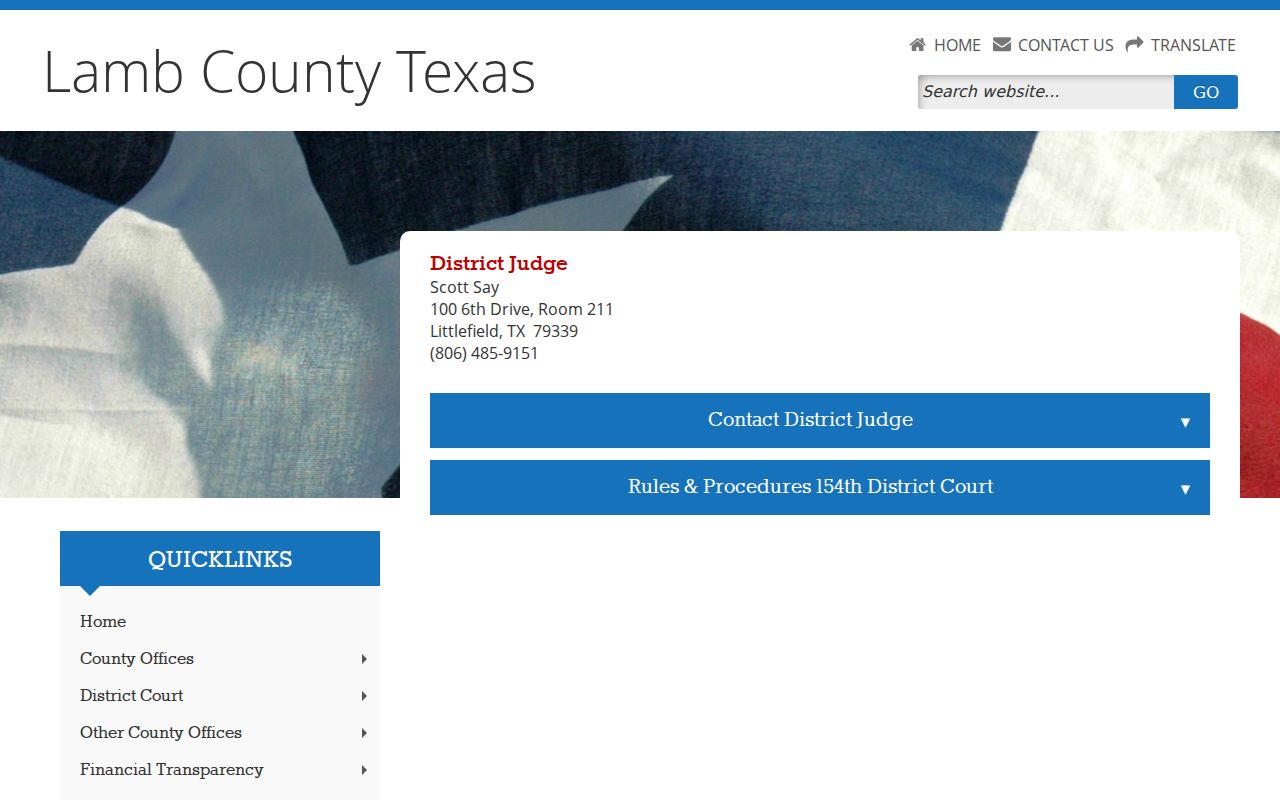
That view identifies the district-court source connected to felony proceedings, while the District Clerk remains the file custodian.
The official Lamb County Court page presents the separate county-level court route.
Its separate role helps explain why misdemeanor files do not belong in the District Clerk's felony set.
The county's County and District Attorney page shows the prosecutor channel that connects charging choices to Lamb County criminal cases.
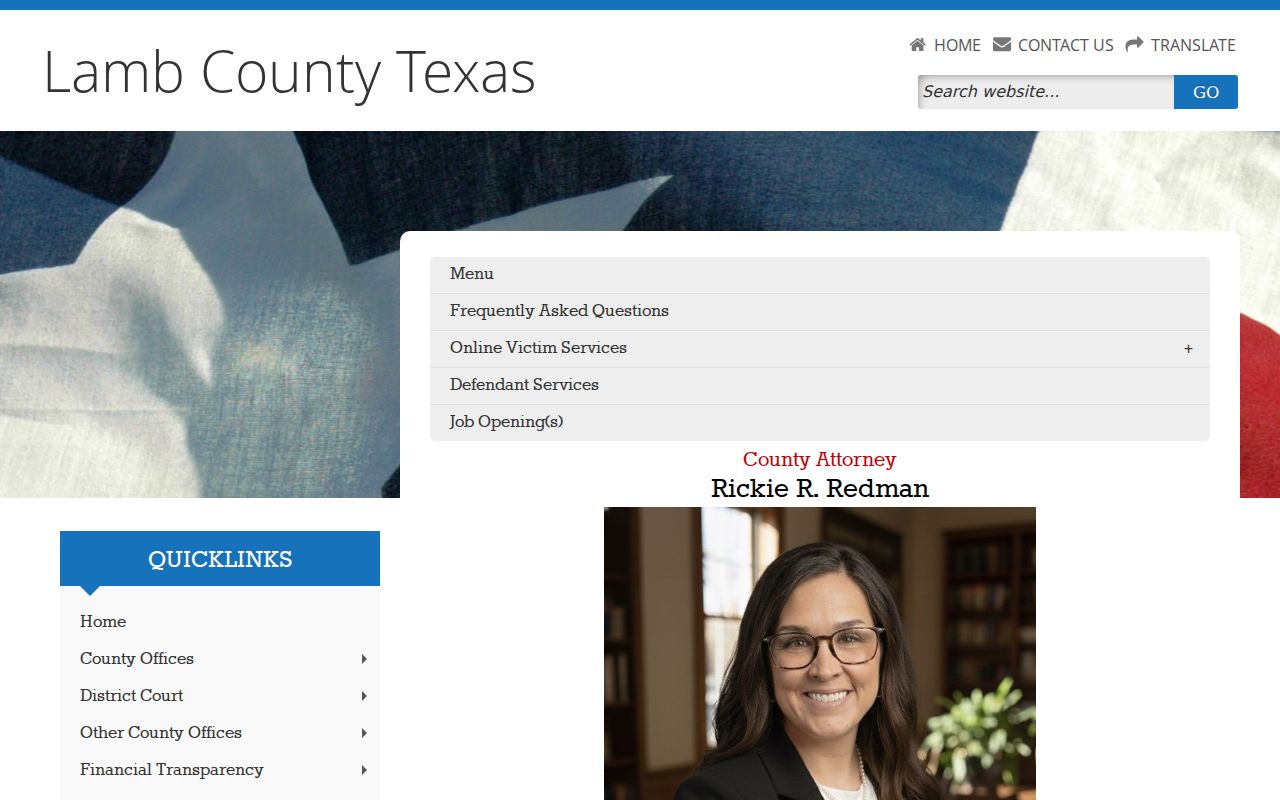
The prosecutor does not keep the official court file, but its filings and case decisions become entries in the clerk's docket.
Lamb County Case Outcome Terms
Short docket labels can be easy to misread. “Pending” means the criminal case remains unresolved, not that the accused is guilty. “Dismissed” means the filed charge ended without conviction on that charge. An acquittal is a not-guilty outcome after trial.
Deferred adjudication is different. It follows a guilty or no-contest plea or finding, with judgment deferred during supervision. Successful completion avoids an adjudication of guilt, but does not by itself erase the Lamb County case record. Texas DPS also places deferred-adjudication information within its public category unless an order of nondisclosure or another restriction applies.
A revocation entry requires its own reading. Lamb County Adult Probation provides community supervision and pretrial bond supervision, but the clerk's judgment and docket remain the public starting point for what the court ordered. A motion to revoke or adjudicate can lead to a hearing, continued or changed supervision, or revocation.
Case Record Access & Restrictions
Texas law does not make every field in every case file public. Juvenile records, protected victim details, medical information, government identifiers, sealed entries, and records covered by an expunction or nondisclosure order may be restricted. A public portal can also omit a record because it was never indexed or because the user's role lacks document access.
Neither clerk publishes a complete local copy or certification schedule on the inspected office pages. Ask for a quote, acceptable payment, mailing terms, and archive time before ordering. If the outcome looks wrong in a DPS record, compare the local certified disposition with a DPS personal fingerprint review and use the Crime Records Division correction route.
Note: A sealed or missing search result does not prove a Lamb County criminal case never existed or that every related agency record was destroyed.